



There is a lot that goes into learning a language. Grammar rules, pronunciation, and spelling. One of the biggest challenges for MLLs (multilingual learners) is grasping all of the new vocabulary that comes along with learning classroom content throughout the school day. And learning new English vocabulary can be difficult, but it doesn’t have to be boring!
Whether you’re teaching English language learners or looking for a fun way to review classroom material, these fun games for teaching English vocabulary get students talking, moving, thinking, and learning together. Best of all, most of them require only a few simple materials!
What Are the Best ESL Activities for Kids’ Vocabulary Development?
The six games below are great for language acquisition. Students learn, use, and practice both productive language skills and receptive language skills. And best of all, they can be adapted for just about any topic! So try one of the games in your ESL class today!
1. Fish Bowl/Adapted Monikers – Fun and creative communication.
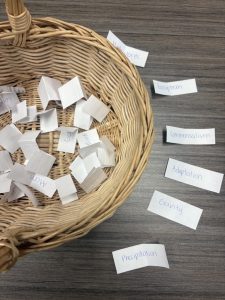 Monikers is a great way to get students excited about vocabulary. The goal is simple: work with your team to guess as many words as possible before time runs out. Students get to practice describing words, acting them out, and thinking of creative ways to communicate.
What you’ll need: Paper, pens/pencils, a bowl, and a timer.
How to play:
- Divide the class into two teams. Have each student write down a vocabulary word on a small piece of paper, fold it, and place it in the bowl. You can use recently learned vocabulary words, animals, objects, or words related to your current unit. If you’re teaching a population unit, pull words from these printable vocabulary cards in the lesson More or Less.
- One player draws one word at a time from the bowl and has 60 seconds to get their teammates to guess as many words as possible by only describing them. Once the 60 seconds ends, the other team has a chance to do the same. Keep alternating until all the words have been correctly guessed.
- Once all the words have been correctly guessed, count the points for each team, return all papers back to the bowl, and mix.
- In the second round, players can only use one word to help their teammates guess while each team takes turns guessing. Other sounds are not allowed.
- In the third round, players must only act out the words without speaking.
Why it works: Students practice vocabulary recall, listening comprehension, speaking, and nonverbal communication. They also learn to explain ideas in different ways when they don’t know the exact word they need. Since they are using the same words for all three rounds, they also put their memory skills to the test!
2. Adapted Imposter – Find the odd one out!
Looking for a game that gets students thinking, listening, and talking? Imposter is a fun way to practice vocabulary while encouraging students to pay attention to what their classmates say.
What you’ll need: Vocabulary cards or slips of paper.
How to play:
- Choose a secret vocabulary word and prepare cards for the students. If your class has just finished the Who Polluted the River? lesson, use a word from the story, like pollution, as the secret word. Everyone but one student receives the same secret word on their card while one student receives a card that says “Imposter.” For bigger groups, include multiple “imposter” cards.
- Have students take turns giving a one word or short clue related to the word without saying the word itself. Do not repeat clues to avoid suspicion from other students. If the secret word was pollution, students might say air, water, or litter.
- The imposter listens carefully and tries to blend in by giving a clue that sounds convincing, even though they don’t know the word.
- After everyone has shared their clue, students discuss their suspicions and vote on who they think the imposter is.
- Reveal the imposter and let the imposter guess the secret word.
Why it works: Students practice describing vocabulary, listening to details, and speaking in complete sentences. It’s also a great opportunity to review recently learned material. For beginner English learners, provide sentence starters such as “I think it is…” or “My clue is…”
3. 20 questions – What am I thinking of?
This is a great game for beginner English learners! Since the answer is always yes or no, it is easier to follow along and fun for everyone.
What you’ll need: Nothing but your imagination!
How to play:
- Have one student think of a person, place, animal, or object without telling anyone what it is. Encourage students to pick something related to the current unit or lesson.
- The rest of the class takes turns asking yes-or-no questions to figure out the answer. It could be helpful to provide a pre-made bank of sample questions like those listed below.
- Keep going until someone guesses correctly or the group reaches 20 questions.
- Let the student who guesses correctly choose the next mystery word.
Common questions are:
- Is it alive?
- Is it a person?
- Is it bigger than a car?
- Can I wear it?
- Does it live in the ocean?
- Is it a character in the class book?
Why it works: Students practice forming questions, understanding answers, and using descriptive vocabulary. Teachers can make the game easier or more challenging by choosing a specific category, such as food, animals, or words from the current unit.
4. This or That – What do you choose?
Sometimes, the best way to get students talking is to get them out of their seats. This or That is a simple activity that encourages students to share their opinions while practicing everyday language.
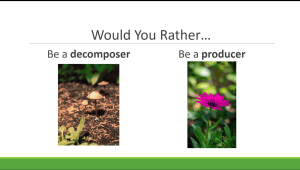
What you’ll need: A slideshow with This or That questions and enough classroom space for students to move around.
How to play:
- Display a question with two choices, such as “Would you rather be a decomposer or a producer?”
- Assign each side of the room to one of the choices.
- Have students move to the side of the room that matches their preference.
- Ask students to explain why they chose that answer.
- Repeat with next questions.
Students learning about ecology could explain which one they chose and what it means. Try questions related to class readings, science concepts, or historic events.
Why it works: Students practice expressing opinions, giving reasons, and listening to different perspectives. To give English learners extra support, provide sentence starters such as “I prefer ___ because…” or “I chose ___ because…”
For more discussion prompts, try the environmental dilemma cards in What Would You Do? Turn one dilemma into two choices and ask students to explain their reasoning.
5. Snowball Fight – Toss around ideas!
Who says you can’t have a snowball fight in the classroom? This activity gives students a fun way to review what they’ve learned and share ideas.
What you’ll need: Writing utensils and paper.
How to play:
- Ask students to write a new vocabulary word on a piece of paper – you can provide a word bank if needed.
- Have students crumple their papers into “snowballs.”
- On your signal, students get to gently toss their snowballs around the room for a few seconds.
- When the tossing stops, everyone picks up a nearby snowball, opens it, reads the word aloud, and shares the definition. For more support, have a list of definitions that students can choose from.
This strategy can be used to review more than just vocabulary. To connect with ELA, students can write down a character name or a favorite quote from a book. When someone opens the snowball, they’ll have to describe/summarize the character or remember who said the quote. Snowballs can also include reviewing questions related to classroom content.
Why it works: Students practice reading, speaking, listening, and recalling information. The activity can also spark interesting conversations and help students connect with their classmates.
6. Beach Volleyball Questions – Pass the question.
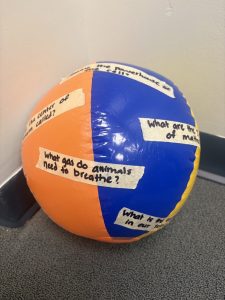 Bring a little summer fun into the classroom with this interactive review game. Students get to move around, answer questions, and learn from one another.
What you’ll need: An inflatable beach ball and a marker.
How to play:
- Write review questions or vocabulary prompts all over an inflatable beach ball. These can relate to a recent lesson or any topic you want students to practice.
- Have students stand or sit in a circle.
- Toss the ball to a student. Ask them to look at where their right thumb lands when they catch it.
- The student answers the question or prompt closest to their thumb.
- Once they’ve answered, they pass the ball to another student, and the game continues.
Questions can be as simple and straightforward as “Which big star gives energy to plants so they can grow?” or as challenging as “Can you use this vocabulary word (example: precipitation) in a sentence?” They can be related to many different subjects including science, math, and social studies.
You can also write review questions about familiar places or issues in your community. For ideas, see these strategies for teaching with local context.
Why it works: Students practice reading, speaking, listening, and recalling information in a relaxed setting. You can adapt the questions to different language proficiency levels, making the activity useful for both icebreakers and lesson reviews.
Try an ESL Vocabulary Game in Your Next Lesson
Whether your students are working on forming sentences or learning new vocabulary, these language learning games are sure to bring new life to your classroom and get ELL students excited to listen, read and speak!
Pick one game and try it with words from your current unit. When you’re planning your next unit, explore our TESOL lesson plans for multilingual learners.
FAQs About Fun ESL Activities for Kids
How to teach ESL vocabulary using fun kids games?
Choose words from a recent lesson and model one turn before students play. In Fish Bowl, students describe, act out, and guess the same words across three rounds, giving them repeated practice with each word.
How to make ESL lessons fun for kids?
Give students a reason to move, make a choice, or solve a mystery. In This or That, students move to the side of the room that matches their choice, then explain it using a sentence starter like “I chose ___ because ___.”
What are fun ESL activities for young kids?
Try 20 Questions with familiar animals, foods, or classroom objects, or play This or That with picture choices. Model a sample question or answer so beginners know how to take their turn.
Interactive ESL speaking activities for primary school kids
Try This or That for giving opinions, 20 Questions for forming questions, or Fish Bowl for describing words. Give beginners sentence starters such as “Does it have ___?” or “You use it to ___.”
Which ESL games keep kids focused and learning?
Use games with short rounds and something for everyone to do. In Adapted Imposter, students listen for clues and vote. In 20 Questions, they build on classmates’ questions to narrow down the answer.
Printable ESL game resources for young English learners
PopEd’s More or Less TESOL lesson includes printable vocabulary cards you can use in Fish Bowl. The What Would You Do? TESOL lesson includes printable environmental dilemma cards you can adapt for This or That.
Low prep ESL activities to entertain young learners
20 Questions requires no materials. For a quick Snowball Fight vocabulary review, all you need is paper, pencils, and a few words from your current unit.