



When people think of genetic modification of food today, they might think of gene splicing in laboratories or GMO labeling in the grocery store. But humans have genetically modified staple food crops for as long as they have practiced agriculture. As soon as human beings began cultivating crops from wild seeds, they began selecting for traits that made those crops better food for people.
What is a Staple Food: Definition
A staple food is a food that people in a region eat regularly and in large amounts; it forms the core of their everyday diet and provides a big share of their calories and basic nutrients.
Common staple foods include rice, wheat, maize (corn), potatoes, cassava, and millet.
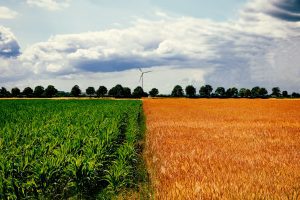
Maize and wheat.
Humans Have Been Modifying Crops for Centuries
Early humans had no concept of evolution or genetic modification, yet people independently around the world began changing the characteristics of staple food crops through careful selection and cultivation for specific traits. This process, known as domestication syndrome, created crops that bear little resemblance to their wild ancestors. Instead, crops became more suitable for human consumption and significantly impacted human history by providing a food supply that was more nutritious and easier to cultivate.
What is Domestication Syndrome?
Domestication syndrome refers to the process through which humans intentionally or unintentionally change a species through domestic cultivation. This process occurred in early agriculture independently all across the world. Regardless of where people lived and which crops they were cultivating, early humans overwhelmingly selected for the following traits:
- Seeds that stayed on the stalk once ripened, known as “non-shattering” seeds
- Larger seed sizes
- Broader conditions under which seeds would germinate
- Improved taste
- Synchronization of flowering times
How Does Domestication Syndrome Change Crops?
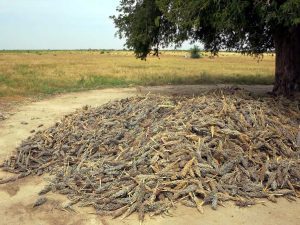
Harvested millet.
When early humans began domesticating crop species like maize, millet, and rice, they grew seeds from plants that showed desirable traits for their species. Through each subsequent harvest and planting season, people continued selecting for traits that made crops more attractive as food for people. This process slowly changed the overall characteristics of these plants and made them very different from the plants that they had been grown from originally.
The Downside of Modifying Crops’ Characteristics
Each selected trait made crops easier to harvest and more attractive for human beings to eat. But these changes included a tradeoff: many of the traits removed by humans had evolved in these species because they improved overall survival for the plant. For example, improving the taste of crops for humans also improved the taste of crops for pests that would eat the crops in the field.
Consequently, the selection of desirable traits in crops also increased the amount of attention that people had to pay to their crops to ensure that they would survive until harvest. As people became more involved in the active cultivation of crops, they began concentrating settlements near their fields.
Example: How Teosinte Became Maize
One of the most famous examples of a staple food crop that was changed through domestication syndrome is maize, which evolved from the teosinte plant that is native to Mexico and Central America. Early Mesoamericans began cultivating teosinte as a food crop nearly 9,000 years ago and repeatedly selected kernels from individual plants that had desirable traits.
Over time, cultivated teosinte gradually changed into a very different kind of plant. Instead of branching stalks each with its own cob, each plant grew a single upright stalk with multiple attached cobs. More kernels were grown on each cob, and those kernels lost the hard coating that protected them from predators. Ears became much larger and did not fall from the stalk as easily as teosinte had.
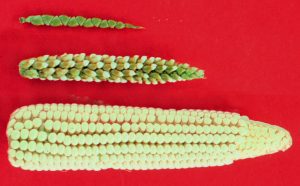
Teosinte on top, maize on the bottom, and a hybrid of the two in the middle.
These changes made maize much more useful as a staple food for Mesoamericans. As early as 4,000 years ago, maize comprised more than 70% of the calories consumed by Mesoamericans. Its versatility as a grain meant that it was used for many functions in people’s diets, including for corn flour and fermentation into a liquid. Archaeologists have even found evidence of popcorn made from teosinte from thousands of years ago.
Today’s Staple Food Crops
Today, the decisions made by early humans continue to have a massive influence on our global diet. Only six crops (cassava, maize, rice, sorghum, soybeans, and wheat) provide more than two-thirds of all calories consumed globally. Each of these crops has been cultivated by humans for thousands of years, and yet these crops now face the possibility of massively declining yields. As global temperatures continue to increase, staple crops that have been adapted for cooler temperatures struggle to survive.
Farmers around the world are responding to these changes much as early humans did: by changing crop varieties and selecting for new traits that make these crops more suitable for their environment. To continue feeding more than 8 billion people all around the world, humanity will have to innovate in our agricultural practices like our ancestors did.
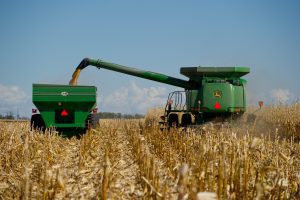
FAQ: Staple Food Crops and How They’ve Changed Over Time
What are staple food crops?
Staple food crops are the foods a population eats most regularly and in the largest amounts. They provide a major share of daily calories and are often easy to store, trade, and grow at scale (like grains and starchy roots).
How have humans “genetically modified” crops for centuries?
Long before modern labs, people changed crops through selective breeding – saving seeds from plants with desirable traits (bigger seeds, better taste, easier harvesting). Over generations, those choices reshaped crops in a process often called domestication syndrome.
What is domestication syndrome?
Domestication syndrome is the set of changes that commonly appear when wild plants become cultivated crops. These include non-shattering seeds, larger seed size, more predictable germination, and synchronized flowering, all traits that help humans harvest and grow crops more reliably.
What’s the downside of modifying crops’ characteristics?
Many domestication traits help people but can reduce a plant’s natural defenses. For example, improving taste for humans can also make crops more attractive to pests, meaning farmers must invest more effort in protecting and managing fields.
Why do staple crops matter for climate change and food security today?
Because so much of the world depends on a few staples, climate stress (heat, drought, changing seasons) can strongly affect yields. Just like early farmers selected crops that fit their environment, modern agriculture must continue adapting crops to keep diets stable for billions of people.
Image credits: Field of maize and wheat (Maize and wheat by uw67 is licensed under CC BY 2.0); Harvested millet in Chad (Millet by D-Stanley is licensed under CC BY 2.0); Teosinte and maize (John Doebley, CC BY 3.0, via Wikimedia Commons); Harvesting corn (Corn Harvest by UnitedSoybeanBoard is licensed under CC BY 2.0.)