



The population expansion of the colonist United States came at the cost of thousands of native peoples’ lives. The Trail of Tears is an example of forced migration, and one that ultimately impacted the population of all people living within U.S. borders.
What Led to the Trail of Tears?
By 1800, the population of the United States had reached over 5 million people and colonists were looking to spread their settlements beyond the land they currently occupied. The Louisiana Purchase in 1803 left the United States with a plot of land to the West of the Mississippi that nearly doubled the size of the country. In addition to this land being intended for colonists to spread farther west, Thomas Jefferson and political allies planned to take land from the Native Nations east of the Mississippi and force native peoples to live on the newly purchased land.
How Did the Indian Removal Act Pave the Way for the Trail of Tears?
Among Jefferson’s allies was Andrew Jackson who, upon entering office in 1829, quickly signed the Indian Removal Act in 1830. This law was designed to assist settlers living east of the Mississippi in taking over land from Native Nations. At this point, the population of the United States (not including American Indians) had more than doubled since 1800 and was approaching 13 million people. Thus began the forceful removal of tribal nations and the many trails of tears that would take place in the 1830s through the 1850s.
There Was No Single Trail of Tears
When speaking of the Trail of Tears, there is a historical focus on the removal of the five “civilized” nations (nations that had assimilated in some ways to colonial government and society). These were the Cherokee, Chickasaw, Choctaw, Muscogee (Creek), and Seminole nations, all located in the southeastern part of the United States in present-day Mississippi, Alabama, Georgia, Florida, and North Carolina.
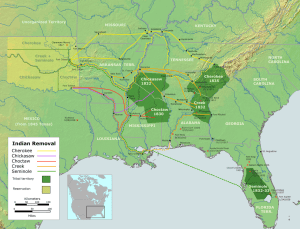
In addition to these most commonly known removals, the Trail of Tears also includes many northern nations who were forced to leave their land due to expanding colonial settlements. The Delawares (Lenapes) (NY, NJ), Haudenosaunees (NY, PA), Ho-Chunks (WI), Kickapoos (IN, OH), Miamis (WI, IN, OH), Ojibwes (Great Lakes area in US and Canada), Odawas (MI), Potawatomis (MI), Sauks and Mesquakies (WI), Shawnees (OH, KY, WV), and Wyandots (Great Lakes Region) are all northeastern nations that were removed against their will from their land.
All of these indigenous nations, from both the southeast and northeast, were made to settle primarily in modern-day Oklahoma. However, the land the U.S. had designated for settlements was not uninhabited. Through a series of treaties, the U.S. government forced the Osage nation living on this land to cede the bulk of their territory for the incoming displaced nations. The removal of all of these nations is reflected in where current American Indian reservations are located.
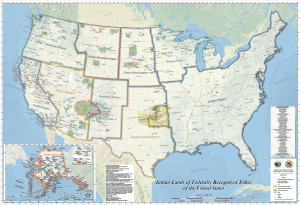
To zoom in on the map, see the original here.
Resistance to Removal
At varying times, tribes signed treaties to sell their land to the U.S. in exchange for land out west, often under coercion and without consent from the majority of the tribe. These treaties were largely broken by the U.S. and tribes did not receive financial compensation for their land for years after they were removed from it. Resistance to these treaties was widespread and took various forms.
In some cases, resistance against forced removal led to wars breaking out between the United States and native peoples: for example, The Seminole Wars. In other cases, indigenous people took a legal route: when a petition protesting the treaty to sell Cherokee land was ignored by the U.S. government, the Cherokee Nation took that case as far as the Supreme Court. They won the case and taking their land was ruled unconstitutional, yet that ruling was not enforced.
Loss of Land and Life
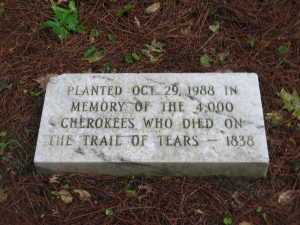 It is estimated that over 10,000 American Indians lost their lives while walking on the Trail of Tears. American Indians were subject to violence at the hands of American troops that enforced their removal and supervised their walk. They were forced to walk thousands of miles and endure other inhumane conditions like hunger, malnutrition, disease, and freezing temperatures. Loss of life also occurred prior to walking the Trail of Tears, both in wars of resistance and when tribes were rounded up and put into detention camps prior to their removal.
Nearly a century after the start of the Trail of Tears, discrimination of Native Nations and their peoples continues to result in loss of indigenous life and constriction of sacred native lands. To learn more about supporting modern day American Indians, explore the Association on American Indian Affairs’ webpage and learn how to become an ally.
Want to Explore Other Population-Related Events?
The Trail of Tears is just one of the over 250 milestones you can explore on the interactive World Population History website. Click through the colorful timeline for summaries of historical milestones related to agriculture, health, society, the environment, and technology that have pushed human population numbers to expand or constrict. See the geographic location of the events on the world population distribution map, where over 9,000 dots represent population change from 1 C.E. through the projection for 2050.
Image credits: Trail of Tears map (User:Nikater, Public domain, via Wikimedia Commons); Tribes of the US (Indian Lands of Federally Recognized Tribes of the United States by the Bureau of Indian Affairs is Public domain); Memorial marker (National Trails Office (US National Park Service), Public domain, via Wikimedia Commons)
Frequently Asked Questions About the Trail of Tears
Can you explain the route of the Trail of Tears?
The Trail of Tears consisted of multiple forced-removal routes rather than one single trail. Native peoples were displaced from areas across the southeastern and northeastern United States and forced to travel hundreds or, in some cases, thousands of miles toward designated lands west of the Mississippi River, particularly present-day Oklahoma.
What was the Trail of Tears in simple terms?
The Trail of Tears was the forced removal of Native American peoples from their ancestral lands by the U.S. government during the 19th century. Thousands of people were made to travel long distances under extremely difficult conditions, and many died from disease, hunger, exposure, violence, and exhaustion.
What was the cause of the Trail of Tears?
The Trail of Tears was caused by U.S. territorial expansion, growing settler demand for Native American land, and federal policies supporting Native removal. The Indian Removal Act of 1830 gave the U.S. federal government greater power to negotiate removal agreements that displaced Native Nations from lands east of the Mississippi River.
What tribes were on the Trail of Tears?
The Trail of Tears is most commonly associated with the Cherokee, Chickasaw, Choctaw, Muscogee (Creek), and Seminole Nations. However, forced removal affected many other Native Nations as well including the Lenape, Ho-Chunk, Kickapoo, Miami, Potawatomi, Shawnee, Wyandot, and others.
How many people died during the Trail of Tears?
More than 10,000 Native Americans are estimated to have died during the forced removals associated with the Trail of Tears. Deaths resulted from disease, hunger, malnutrition, exposure to extreme weather, violence, and the severe conditions people experienced both during removal and in detention camps before the journeys began.
When did the Trail of Tears begin and end?
The forced removals commonly associated with the Trail of Tears intensified after the Indian Removal Act was passed in 1830. Major removals took place throughout the 1830s, including the Cherokee removal of 1838–1839, although forced displacement of Native Nations continued into the following decades.
What was the Indian Removal Act?
The Indian Removal Act of 1830 was a U.S. law that authorized the federal government to negotiate agreements for the relocation of Native Nations living east of the Mississippi River to lands farther west. In practice, these policies led to coercive treaties, widespread displacement, loss of Native lands, and the forced migrations now associated with the Trail of Tears.