



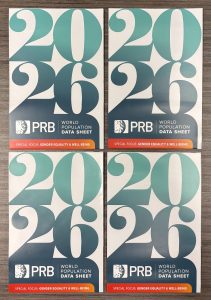
 We consider the World Population Data Sheet (WPDS), from the Population Reference Bureau (PRB), the most user-friendly resource for global demographic data and a great addition to the classroom. The well-organized data is easy to access and follow, making it a perfect research source for middle and high schoolers. For the same reason, teachers love to use the Data Sheet when developing lesson plans and activities that incorporate data literacy.
Last fall, Population Connection (PopEd’s parent organization) was delighted to award PRB a major grant to produce the printed World Population Data Sheet and accompanying interactive digital platform for 2026. The new edition has now been published and you can access the World Population Data Explorer here! As always, it will provide the most recent data on demographic indicators for more than 200 countries and territories, meticulously researched and validated by PRB’s expert team of demographers and data analysts.
An Important Source of Demographic Data
For over six decades, the World Population Data Sheet, published by the Population Reference Bureau, has served as a foundational demographic reference. The data sheet was not only a reliable source for classrooms, but also for newsrooms, research institutions, nonprofit organizations, and government agencies around the world.
Teaching with the Data Sheet
We know that many teachers have relied on PRB’s World Population Data Sheet in their teaching. We also know that students use the datasets on PRB’s website for research on global and country-based demographics, economics, health statistics, and more.
Here at PopEd, we rely on PRB data sets too. Many Population Education activities, case studies, and digital tools incorporate the data sets directly or use the data for foundational context. Additionally, we proudly distribute the printed wall chart to thousands of educators in our teacher workshops each year.
That’s why we were disheartened when the future of the WPDS was in doubt after its primary funder, USAID, was dismantled by President Trump’s administration. As a result, PRB did not produce the WPDS in 2025.
Disappearing Data
Unfortunately, the loss of the WPDS was part of a larger trend. Reliable, well-researched data sets on demographic, development, and environmental indicators are disappearing from government websites. In some cases, it’s because of staff or budget cuts, but at other times it’s because the statistics do not align with political narratives related to health, climate change, social justice, etc.
Without warning, the CIA recently ended publication of The World Factbook, an almanac of country information used by millions of teachers, researchers, and journalists for over 60 years. Other data sets and interactive tools in the public interest have been eliminated or no longer maintained from several other U.S. agencies, including the EPA, NOAA, and CDC.
While the UN websites are key sources of international data on population, health, and development, their data formats are often not designed for easy use by teachers and students. That’s what makes PRB’s World Population Data Sheet so vital – it’s well-designed and accessible for all users, including middle and high school students.
Share Your Experiences
 Join us in celebrating the return of the Data Sheet! If you’re a teacher who uses PRB’s World Population Data Sheet, we’d love to hear from you. Your comments can help PRB make this an even more useful tool for the classroom, and your tributes can provide evidence to future funders that this is a valuable resource that should continue to be updated and made available to the public.
Share your thoughts, feedback, and stories of using the World Population Data Sheet by clicking here.
Updated: September 22, 2026