



The United States has long been considered a “nation of immigrants.” Nearly all of us who call the U.S. home (except those who can trace all their lineage to indigenous groups) are here because of immigration – either voluntarily or involuntarily (as with the slave trade).
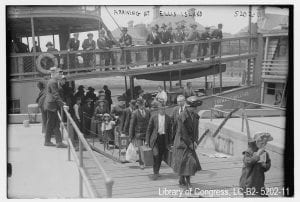
Elementary social studies curriculum often teaches students that U.S. society is a “melting pot,” that has welcomed newcomers from across the globe, and that this diversity of nationalities has contributed to America’s ingenuity and economic success. Yet, from America’s founding to present times, there has been little consensus on who should be welcomed to live and work here, and to become citizens.
In our high school activity, Nation of Immigrants, we tell the story of shifting U.S. policies around immigration, sometimes rooted in xenophobia, and other times focused on pragmatism and compassion. Over the decades, Congress has enacted legislation to open and close the doors to different groups of people based on race, country of origin, and job skills, as well as humanitarian considerations such as reuniting families and providing refuge from natural disasters, wars and persecution.
How Has Immigration Policy Shifted Throughout U.S. History?
Historically, changes to immigration policy happened through Congress taking action. Legislation, or laws, guided how the United States handled immigration and immigrants. In more recent years, we’ve seen an increase in immigration policy happening through executive actions taken by presidents.
Major Immigration Legislation in U.S. History
Let’s first look at U.S. immigration legislation. This chart details laws that were enacted by Congress. Laws remain in force unless repealed or replaced by future acts of Congress.
Timeline of Major U.S. Immigration Legislation |
||
| Year | President | Legislation |
| 1790 | George Washington | Naturalization Act of 1790: Allows “free white person[s)” to become naturalized citizens after living in the U.S. for two years. This is extended to five years under the Naturalization Act of 1795. |
| 1798 | John Adams | Alien and Sedition Acts: Raises the minimum waiting time of naturalization to 14 years and gives the president power to imprison and deport any immigrant considered dangerous. The waiting time is reduced to 5 years in 1802. |
| 1864 | Abraham Lincoln | Immigration Act of 1864 (also known as An Act to Encourage Immigration): Addresses labor shortages due to the Civil War with legally binding contracts for immigrant labor from abroad. It also creates a commissioner of immigration, appointed by the president to serve under the secretary of state. |
| 1868 | Opposed by Andrew Johnson | 14th Amendment to the Constitution guarantees that anyone born or naturalized in the US is a citizen, regardless of race. |
| 1882 | Chester Arthur | Chinese Exclusion Act: Bans all immigration from China and prevents naturalization of Chinese immigrants already in the U.S. (the first immigration act to exclude a specific group of people). |
| 1892 | Benjamin Harrison | Geary Act: Extends the Chinese Exclusion Act and requires Chinese immigrants in the U.S. to carry certificates of residence to prove their legal status. |
| 1917 | Passed over veto by Woodrow Wilson | Asiatic Barred Zone Act: Prohibits immigration from a “barred zone” encompassing much of Asia (except Japan and Philippines); and mandates literacy tests for immigrants over age 16. |
| 1921 | Warren G. Harding | Emergency Quota Act: Limits the number of immigrants of each nationality allowed to immigrate to the U.S. each year to 3 percent of the number of foreign-born persons of that nationality present in the U.S. as of the 1910 census. |
| 1924 | Calvin Coolidge | National Origins Quota Act: Further limits the annual immigration quota of each nationality to 2 percent of its proportion of the U.S. population based on the 1890 census (1890 was prior to the admission of large numbers of southern and eastern European immigrants in the early 1900s.) Also, that year, Congress establishes the U.S. Border Patrol to combat illegal immigration and smuggling along the borders. |
| 1943 | Franklin D. Roosevelt | Magnuson Act: Repeals the Chinese Exclusion Act and allows Chinese nationals to become U.S. citizens. |
| 1948 | Harry S. Truman | Displaced Persons Act of 1948: Allows admission of over 350,000 refugees from Europe following World War II. |
| 1952 | Passed over veto by Harry S. Truman | Immigration and Naturalization Act: Reaffirmed the quota system from 1924 but allows very limited immigration from Asia, created a hierarchy system for visas including labor preferences. |
| 1953 | Dwight D. Eisenhower | Refugee Relief Act of 1953: Authorizes the admission of up to 205,000 non-quota immigrants fleeing persecution or have been expelled from their homes in Europe. |
| 1962 | John F. Kennedy | Migration and Refugee Assistance Act of 1962: Authorizes funds to assist refugees from the Western Hemisphere who have fled their countries due to persecution or fear of persecution on account of race, religion or political opinion. The law is intended to assist Cuban nationals fleeing Communism. |
| 1965 | Lyndon B. Johnson | Immigration and Nationality Act of 1965: Replaces the quota system with a set of seven preference categories, prioritizing family reunification and highly skilled professionals. Creates a per country cap on each country (7% for any specific category). Eliminates literacy tests in areas with historic discrimination. (This ban on literacy tests in extended to the whole country in 1970. |
| 1972 | Richard Nixon | 1975 Indochina Migration and Refugee Assistance Act: Expands on the definition of “refugee” from 1962’s law to include people fleeing persecution or fear of persecution from Cambodia and Vietnam. |
| 1980 | James Carter | Refugee Act of 1980: Establishes a new system for processing and admitting refugees from any country overseas as well as asylum seekers present at U.S. borders or in the country. |
| 1986 | Ronald Reagan | Immigration Reform and Control Act: Legalizes nearly 3 million undocumented immigrants and introduces employer sanctions for hiring unauthorized workers. The law substantially increases border patrol staffing. |
| 1990 | George H.W. Bush | 1990 Immigration Act: Raises the annual legal admissions limit from 290,000 to 675,000, mainly for employment-based visas (“green cards”). It also establishes Temporary Protected Status (TPS) for nationals of countries deemed unsafe for return because of armed conflict or natural disaster. Creates the Diversity Visa Program, which allots green cards for immigrants from countries with little immigration to the United States. |
| 2025 | Donald Trump | One Big, Beautiful Bill Act: Funds a dramatic expansion of the U.S. immigration detention system, implements high fees for asylum applications and work authorization applications for newcomers. Strips eligibility for federally funded health programs from refugees and asylees, including children. |
Over the past 25 years, there have been several attempts by legislators to enact comprehensive immigration reform to address several concerns including the long backlog of asylum applications, the millions of undocumented immigrants seeking a path to citizenship, the need for skilled workers and for maintaining security of U.S. borders. These attempts have failed repeatedly as immigration issues have become increasingly partisan and polarizing. In the absence of legislation, most immigration policy in recent years has been made through presidential executive orders.
Modern-Era Executive Actions on Immigration
This next chart lists executive orders on immigration. Unlike legislation, an executive order is created by the President alone and does not require Congressional approval.
Timeline of Executive Orders on Immigration |
||
| Year | President | Executive Order |
| 2012 | Obama | President Obama creates the Deferred Action for Childhood Arrivals (DACA), enabling young adults brought to the U.S. illegally as children prior to 2007 to apply for temporary deportation relief and work permits. This program is expanded in 2014. |
| 2017-2021 | Trump | During his first administration, President Trump issues orders on border wall construction, increased immigration enforcement and travel restrictions on several nations. |
| 2021 | Biden | President Bident revokes several Trump-era executive orders, prioritizes felons for deportation, and seeks to address the root causes of migration. |
| 2025-2026 | Trump | In his second administration, President Trump issues new orders aimed at ending birthright citizenship, reducing the number of admitted refugees and asylees, increasing border security, and placing travel restrictions on 38 countries, including limits on student visas. |
As opposed to enacted laws, executive orders can be easily revoked by future presidents and/or deemed illegal by the judicial system. For instance, the DACA Program instituted in 2012 has been mired in the courts ever since, putting the future of half a million young adults in limbo.
 Teaching About U.S. Immigration History
This complicated legislative history around immigration, as well as our current situation, can be explored in Nation of Immigrants, part of our 330+ Million in the USA lesson packet. To commemorate America 250, the packet has been newly updated and is available for free download. It is designed to supplement student instruction in U.S. History and Government courses.
FAQs
What is the difference between immigration laws and executive orders?
Immigration laws are passed by Congress and remain in effect until repealed or replaced. Executive orders are issued by the president and can be reversed by future administrations or challenged in court.
Why has immigration reform become so controversial?
Immigration reform remains highly debated because it involves issues such as border security, undocumented immigration, asylum processing, economic needs, and pathways to citizenship. Political divisions have made comprehensive reform difficult to pass.
How have presidents influenced immigration policy in recent years?
Recent presidents have relied heavily on executive actions to shape immigration policy, including programs like DACA, travel restrictions, refugee policies, border enforcement measures, and asylum rules.
What educational resources are available for teaching U.S. immigration history?
The “Nation of Immigrants” lesson in the 330+ Million in the USA packet provides students with an overview of U.S. immigration history, legislation, and executive actions from America’s founding through today.
Image credits: Immigrants at Ellis Island, 1915-1920 (Arriving at Ellis Island by The Library of Congress is Public domain)