



State voting maps have long been manipulated for political gain by whichever party is in power. After the 2020 Census, we published a new activity, The People’s House, to help students explore the history of reapportionment and gerrymandering that typically occur every ten years following each national census. The U.S. is now in the midst of an unprecedented redistricting war that is scrambling voting maps at a fever pitch and threatening to weaken democratic representation for the foreseeable future. Understanding how and why voting maps are changing so radically, and the implications for our democracy, is critical content for high school social studies classes.
Gerrymandering Activity for High Schoolers
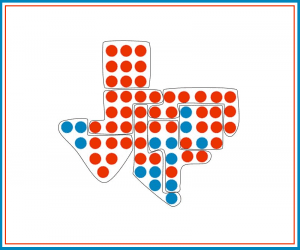 Since the nation’s founding, gerrymandering has been a tool used to game the system, enabling politicians to choose their voters, rather than the other way around. As the U.S. population grew steadily, ways to divide the maps also increased. The People’s House lesson explains the concepts of “cracking” and “packing” – separating (cracking) voters with similar voting habits into other districts to dilute their vote or packing voters from spread-out areas into one district to lessen their voting impact on the state.
The Redistricting Wars of 2026
The redistricting war started in 2025 when President Trump urged governors and legislators in Republican-controlled states to create new voting maps mid-cycle, five years before the 2030 Census, in an effort to wrest more Congressional seats for his party prior to the 2026 midterm elections. Texas lawmakers took up the challenge first to create more “red” districts. California countered with measures to create more “blue” districts, and the map redrawing frenzy soon resulted in eight states adopting new voting maps with four others in the works as of May 2026.
SCOTUS Upends the Voting Rights Act
Just when it looked like the maps couldn’t get much more contorted this spring, the U.S. Supreme Court struck a further blow to proportional representation by gutting what remained of the Voting Rights Act (VRA) of 1965. This landmark legislation, signed into law by President Lyndon B. Johnson, was enacted to defeat the “Jim Crow” laws in Southern states with a long history of disenfranchising Black voters. The 15th Amendment had guaranteed that the right to vote should not be denied because of race, but Southern states had subverted that mandate for nearly a century. The VRA made barriers to voting (including literacy tests and poll taxes) illegal and prohibited states from creating voting maps designed to dilute Black representation.
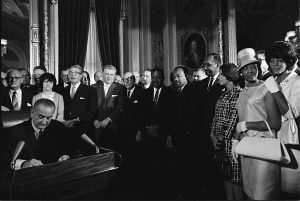
President Lyndon B. Johnson signs the Voting Rights Act of 1965 while Martin Luther King Jr. and others look on.
In Louisiana v. Callais (2026), the Court’s Conservative majority raised the bar for what constitutes racial gerrymandering, arguing that anyone challenging voting maps for racial bias must prove that a state intentionally redistricted to diminish the opportunity for minority voters.
Previous Supreme Court decisions had already green-lighted redistricting for partisan advantage. In Rucho v. Common Cause (2019), a case regarding North Carolina’s gerrymandered map, Chief Justice Roberts wrote for the Conservation majority that questions of a political nature are “nonjusticiable,” or outside of the judiciary’s power to decide. Writing for the dissent, Justice Elena Kagan argued that “[p]artisan gerrymandering of the kind before us not only subverts democracy (as if that weren’t bad enough). It violates individuals’ constitutional rights as well.”
Consequences for Racial Representation
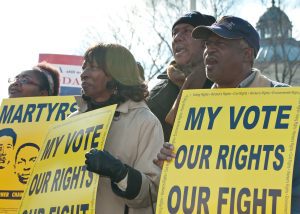 The latest Court decision will enable Louisiana and other solidly “red” Southern states with large Black populations (who mainly vote “blue”) to redistrict in a way that marginalizes the Black population, all in the name of permissible political gerrymandering. Tennessee and Alabama have recently seized on this decision to begin redrawing their own maps to try to erase Black representation. For instance, Memphis, a majority Black city (65 percent) that makes up much of Tennessee’s “blue” 9th District is set to be divided three ways with each section joining a solidly red district. This will effectively ensure that all nine Tennessee districts are “red” and will remove representation from Black voters who comprise 17 percent of the state’s electorate.
From 1900 until the VRA was enacted in 1965, there were no Black legislators representing the 15 states where slavery had been legal, and only six in the entire country. It took until 2025 for the number of Black Representatives to match their proportion in the country (62 of the 435 members, or 14 percent), all due to the VRA and a 1982 amendment that strengthened the law. Redistricting experts project that the new redistricted maps could set up the largest-ever decline in the number of Black representatives on Capitol Hill since Reconstruction.
Make the House Bigger?
With the size of the U.S. House of Representative capped at 435 since 1929, the population of each district grows, also changing the nature of representation for all U.S. citizens. Back then, each House member represented approximately 280,000 people. Today, that number has risen to 780,000.
Part 1 of The People’s House lesson plan provides students with primary source readings (from the Federalist Papers to contemporary op-eds) to help inform a classroom debate on lifting the cap and growing the size of House of Representatives. Part 2 invites students to try their hand at cracking and packing simplified state population maps. Considering the increased relevance of the activity, we’ve published an updated version, available for free download as part of the curriculum, 330+ Million in the USA. In addition to aligning with many states’ social studies standards, the activity also addresses AP U.S. Government Unit 2 (Interactions Among Branches of Government) and AP Human Geography Unit 4 (Political Patterns and Processes).
FAQs
What is the Voting Rights Act?
The VRA, enacted in 1965, made barriers to voting – like literacy tests and poll taxes – illegal and prohibited states from creating voting maps designed to dilute the representation of Black voters.
What did SCOTUS recently do to the Voting Rights Act?
SCOTUS weakened the law considerably by making it very difficult for plaintiffs to prove that racial bias motivated the redrawing of voting maps.
How will Louisiana v. Callais decision impact voting?
State lawmakers can redraw voting maps that eliminate majority Black districts, dilute the Black vote in other districts, and effectively diminish the number of Black Representatives in the U.S. House of Representatives.
How many people does the average member of the House represent?
On average, a member of the House represents 780,000 constituents.
What is gerrymandering?
Gerrymandering is the practice of drawing district maps to favor one political party or group. This can involve concentrating opponents into a few districts or spreading them across many districts to weaken their voting power.
What is a good activity to teach gerrymandering?
The People’s House lesson plan provides simplified state population maps for students to gerrymander using cracking and packing techniques. The lesson is printer-ready and free to download.
Why does redistricting matter so much?
Redistricting can influence election outcomes for an entire decade. Even small changes to district boundaries can affect which party is more likely to win seats, making redistricting a major source of political power.
Image credits: Signing of the Voting Rights Act (Yoichi Okamoto, Public domain, via Wikimedia Commons); Rally in 2013 on protecting the Voting Rights Act (Protect the Voting Rights Act rally at the SCOTUS by SEIU is licensed under CC BY-NC-SA 2.0)