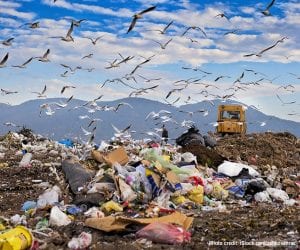



Overconsumption has global consequences, some of which we may not be able to see in our day-to-day life. Documentaries can help students see not only those consequences, but also how and why overconsumption has become an issue.
Below are some documentaries featuring a range of issues surrounding human overconsumption. Whether you prefer one covering consumption habits in general or one with a specific focus such as the fashion industry, there is a documentary for you.
We’ve listed documentaries that are perfect conversation starters in any classroom and have paired each with a lesson or reflection to expand on learning from the viewing.
Five Classroom Movies on Consumption
 1. Textile Mountain – The Hidden Burden of Our Fashion Waste (YouTube – 21:38)
In Textile Mountain, your students will learn how the over-production of clothing and textiles impacts global communities. Specifically, students meet people in Nairobi, Kenya who import and sell mitumba (second-hand clothing) in markets. The clothing comes from countries in Europe and North America and is often not high quality enough to be resold, so instead gets discarded. The documentary shows the impact that the trashed clothing has on the environment and the health of local people.
Lessons to pair with the film Textile Mountain:
Secret Life of Stuff (6-8): Follow the life cycle of four items from production to the end of their life. Jeans, sneakers, earbuds, and lamps, the four items students will evaluate, all have an environmental impact before they reach our hands and after they are thrown away. This activity will illuminate that impact and have students reflect on the influence companies and their consumers have on the size of that impact.
Trash Trouble in Paradise (9-12): Introduce students to the concept of environmental justice and who is impacted by pollution from factories, power plants, landfills, or waste sites. Explore a case study on the Hawaiian Island O’ahu and their Waimanalo Gulch Sanitary Landfill. Students investigate how O’ahu is handling the landfill being at capacity, who sees the consequences of this, and where to go from here.
 2. Just Eat It: A Food Waste Story (YouTube – 1:13:20)
In the documentary Just Eat It, your students follow a couple as they spend 6 months living off of food waste in their area. The food they find outside of grocery stores, in wholesale vendors’ dumpsters, and from family and friends sustains them for these months. While following their journey, students learn from farmers about the process of growing food and how much energy and water is being wasted when food is wasted. Students are able to see not only the role that individuals play in food waste, but how much food is destroyed before even making it to our plate.
Lessons to pair with the documentary Just Eat It: A Food Waste Story:
Scraps into Soil (K-5): Students conduct a lab activity to compare how different items decompose over time. They will understand the difference in how organic vs. inorganic materials decompose and the harm it may cause when items do not break down. Students also discuss the benefits of compost and how to make it using food leftovers and waste.
Every Drop Counts (K-5): Part 1 of the lesson has students keep track of how much running water they and their households use in an evening. Based on their collected data, they consider how much water is used in their entire town, in their state, and in their country. Part 2 of the lesson looks at indirect water use in the food we eat and materials we use. The lesson puts into perspective how much water is used not only directly from a faucet but in other common daily resources.
Bonus: Looking to empower students with solutions? Check out these services:
1. Misfits Market is a grocery service that takes foods that may not be able to be sold in big stores for aesthetic or other reasons and distributes them to the public.
2. Too Good To Go is an app designed to reduce food waste. On the app you shop from local participating restaurants, pay a discounted price for the food, and pick up the food at the specified time (often close to closing time you pick up food that would be wasted at the end of the day).
 3. Neuromarketing: How brands are getting your brain to buy more stuff (YouTube – 11:36)
Learn how companies are using our brain and our physical reactions to enhance their marketing techniques in the short film Neuromarketing. Students will discover how companies track things like what eyes follow on a screen and what raises heart rate, and then use those images in advertising to get people to buy certain products. Learn about how subliminal marketing, frequent product releases, and the tactic of wearing people down over time contributes to our spending habits and consumerism culture.
Reflection to pair with the short documentary Neuromarketing:
How did it make you feel to learn about the data companies track to build their advertisements? Will it change the way you view advertisements? Why or Why not?
Can you think of a real-world example you have experienced in which companies have used your “system 1” thinking mode to get you to buy things?
 4. Minimalism (YouTube – 1:17:59)
While watching the film Minimalism, your students can unpack what it looks like to reject the stereotypical “American Dream” of a bigger house, more stuff, and the highest paying job possible. Journey with individuals as they identify overconsumption as the cause of their stress. The phrase “keeping up with the Joneses,” (buying more to keep up with those around us) has been normalized since 1913 when a comic strip was published with the title centered around a family trying to match the lifestyle of the family next door – the Jones. Imagine a life that turns that mentality on its head and is free from pressures of buying for the sake of buying.
Lessons to pair with the movie Minimalism:
For the Common Good (3-12): In this simulation game, students will share a set of common resources and have a powerful motivation to collect those resources for themselves. In the first round, see the impact of acting with short-term consumption strategies in mind. After adjusting some rules for the second round (and all following rounds), observe the changes in consumption patterns and how that impacts the longevity of the simulated world students are playing in.
To Consume or Not to Consume, from Defining Moments Canada: Students investigate the trend of de-influencing and the role social media plays in consumerism. By watching videos on de-influencing, playing a card game, and reading an article on capitalism and the impact it has on daily lives, students will develop their own perspective on overconsumption. Finally, they will create their own video to de-influence others from purchasing a product that they have identified as over-consumed and potentially bad for the environment.
 5. Buy Now! The Shopping Conspiracy (Netflix – 1:24:00)
Follow the documentary Buy Now! The Shopping Conspiracy through the five rules that make a “successful” business: sell more, waste more, lie more, hide more, control more. The documentary features former top executives of well-known brands reflecting on their time with the companies and the contributions they made towards encouraging overconsumption. Explore the far-reaching consequences of mass-consumption and how brands manipulate our reality to encourage it. Ask, and have answered, the questions: Is overconsumption the consumer’s fault or the brands telling them to consume? What impact does mass production have on the planet? What can be done about all of this?
Lesson to pair with the Buy Now! documentary:
Consumerism and Sustainability lessons, from ACT: The Association for Citizenship Teaching (ACT) has developed a pair of lessons to specifically accompany the documentary Buy Now! In the first of these two lessons, students will dive into how advertising impacts our consumption and the environmental impact of impulsive purchases. The second lesson has students understand and investigate the idea of brands designing a product that intentionally has a short lifespan and requires replacement often.
Overconsumption Films for APES
We know that AP Environmental Science teachers love to supplement the APES course with films. The movies listed here are perfect for APES Unit 6: Energy Resources and Consumption. And with most of them available on YouTube, they’re easy to access and stream in your classroom.
Frequently Asked Questions
What are some must-watch films on the topic of waste and overconsumption?
Some must-watch documentaries about waste and overconsumption include Textile Mountain, Just Eat It: A Food Waste Story, Minimalism, Buy Now! The Shopping Conspiracy, and Neuromarketing. These films explore topics such as fast fashion, food waste, advertising psychology, and the environmental impact of consumer culture.
Can you recommend documentaries that focus on the environmental impact of consumerism?
Yes. Documentaries such as Textile Mountain and Just Eat It: A Food Waste Story specifically focus on how consumer behavior contributes to pollution, landfill growth, wasted resources, and environmental injustice. These films are especially useful for sustainability and environmental science classrooms.
What is the best consumerism documentary for students?
For classroom use, Minimalism, Just Eat It, and Neuromarketing are highly engaging consumerism documentaries for students. They encourage discussion around advertising, social pressure, waste, and sustainability while remaining accessible to middle school and high school audiences.
Why should teachers use overconsumption and consumerism documentaries in the classroom?
Overconsumption and consumerism documentaries help students connect real-world environmental issues to their everyday lives and the systems we’re all a part of. They can support lessons in environmental science, economics, social studies, media literacy, and sustainability education while encouraging critical thinking and discussion.